TURZX 3.5" Smart Screen / A Reverse Engineering Attempt Gone Wrong

Do not disassemble this display unless you are prepared to risk permanently damaging the LCD.
The LCD panel is extremely fragile, and the enclosure uses tiny screws with a construction that makes separating the assembly surprisingly difficult.
I ended up cracking the display while trying to open it.
This post is documenting that mistake specifically so someone searching for TURZX 3.5" disassembly, Turing Smart Screen teardown, USB35INCHIPSV2, or VID_1A86&PID_5722 sees this warning before making the same mistake.
Recently, I bought a TURZX / Turing Smart Screen 3.5-inch to use as a small secondary telemetry display for my PC.
Like many inexpensive hardware devices, the configuration software that comes with it doesn't have a Linux version.
Yes, I know about the open-source project turing-smart-screen-python. I actually tested it and, surprisingly, it worked partially with my screen. However, some things didn't work correctly, which made me suspect that perhaps my model used some small hardware or protocol variation.
So, naturally, I started reverse engineering it to find out how it actually worked and, hopefully, add full support for my model.
Everything was going reasonably well.
I was reading the turing-smart-screen-python source code and matching it against the packets sent by the official software using Wireshark. Little by little, some things started to make sense.
Until I had the brilliant idea of opening the screen so I could see and document the internal components.
And, of course, that didn't go very well.
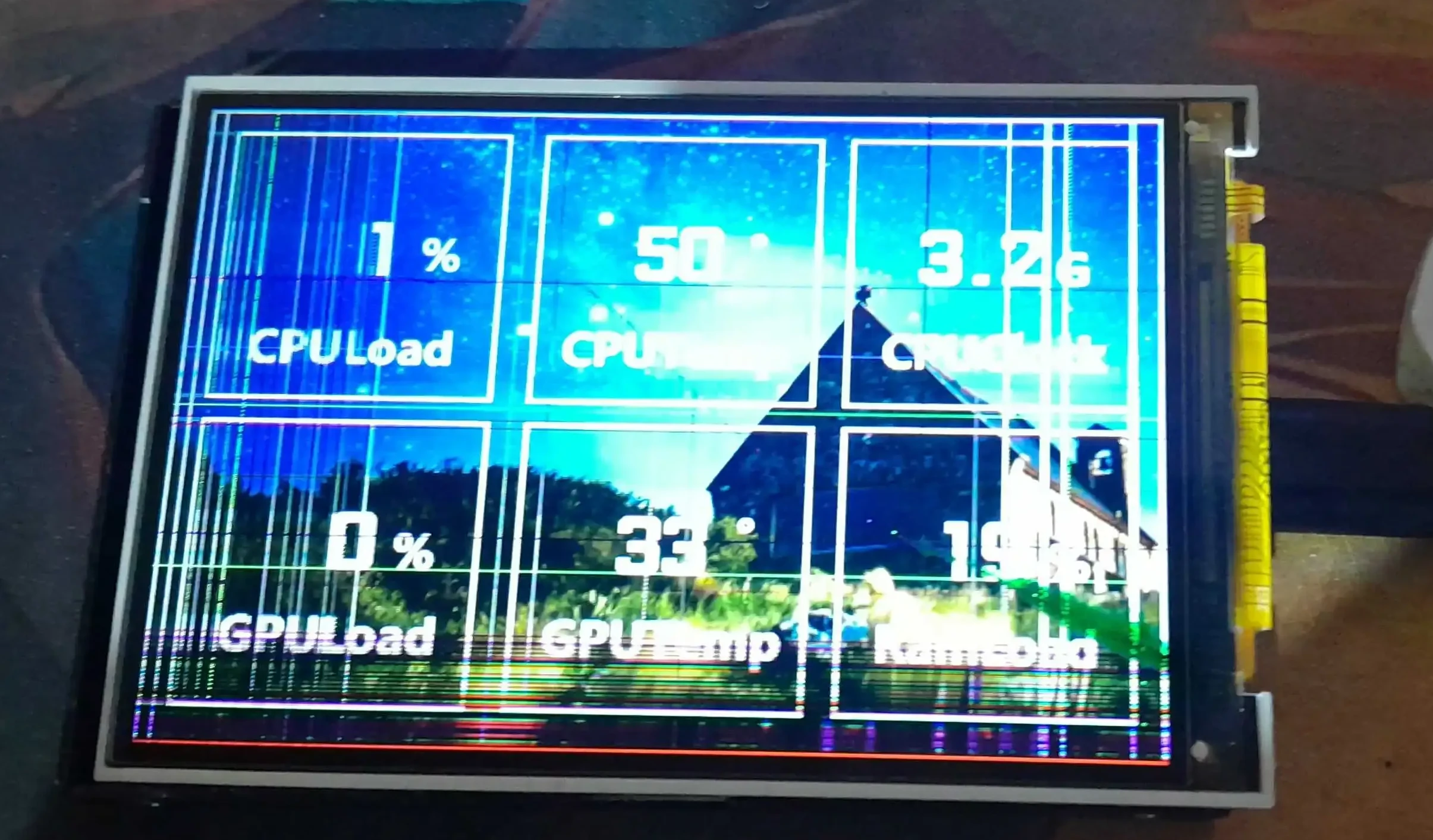
Yeah.
The screen was way too fragile, and I ended up damaging the LCD during disassembly.
So, instead of a complete teardown, this post ended up becoming a mix of hardware documentation, some protocol findings, and a warning to prevent someone else from making exactly the same mistake I did.